Planning today for multiple shipping futures
Shipping is navigating a structural shift where long-term capital allocation must be made against an increasingly volatile and unpredictable backdrop.
With typical vessel asset lives spanning 20 to 25 years, newbuild and fleet decisions made today will directly shape operational viability and compliance through 2050. Over that horizon, fuel markets, regulatory requirements, carbon pricing mechanisms, and technologies will eventually converge, but the current path remains quite turbulent.
DNV's Maritime Forecast to 2050 – 2026 edition highlights this core challenge for the maritime energy transition. Rather than pointing to a single pathway, the report examines four different regulatory scenarios and their potential impact on fuel demand, compliance costs, ship energy efficiency, and fleet strategies.
For shipowners, the challenge is therefore not simply to identify the fuel of the future. It is to build optionality and robust fleet strategies that can perform across multiple regulatory, fuel, and technology outcomes.
A vessel requires a defined amount of energy to fulfil a mission. This energy can be provided by a combination of conventional fuels, low-GHG alternative fuels, and wind propulsion. While many variables remain difficult to predict, one foundational factor can already be addressed today: reducing the total energy required from bunkered fuels by harnessing the free energy offered by wind-assisted propulsion directly at sea.
Fuel dependency is becoming a strategic exposure
Fuel has always represented a significant part of vessel operating costs. The maritime energy transition is adding new dimensions to that exposure.
Conventional marine fuels face increasing regulatory and carbon-related costs. At the same time, the future economics and availability of future marine fuels, particularly low-GHG fuels, remain uncertain.
According to DNV, shipping demand for low-GHG fuels could range from 4 to 22 Mtoe by 2030, depending on regulatory developments. By 2050, demand could reach 33 to 185 Mtoe.
Supply adds another layer of uncertainty. DNV estimates that current project pipelines could deliver a maximum of 270 Mtoe of low-GHG fuel supply by 2030, while noting that actual volumes are likely to be lower due to project delays, cancellations, and other uncertainties.
Shipping will also not be the only industry competing for these energy sources. As demand develops across different sectors, competition for fuels and feedstocks is expected to place further pressure on both availability and cost.
The implications for fleet operators extend beyond emissions: fuel strategy is increasingly connected to long-term operating costs, availability, and competitiveness.
Reducing fuel demand therefore reduces exposure to factors that shipowners cannot fully control.
Wind in the fuel mix: a hedging factor across regulatory pathways
DNV’s 2026 Maritime Forecast puts four very different regulatory futures on the table, from adoption of the IMO Net-Zero Framework to prolonged regulatory gridlock.
The resulting fuel mixes, technology choices and cost exposure vary significantly. Yet one requirement remains remarkably consistent across every scenario: ships need to reduce the amount of energy they draw from purchased fuels.
DNV estimates that stronger global regulatory signals could enable the global fleet to consume up to 25% less energy by 2050 compared with a pathway driven primarily by regional regulation.
This is where wind deserves to be considered differently.
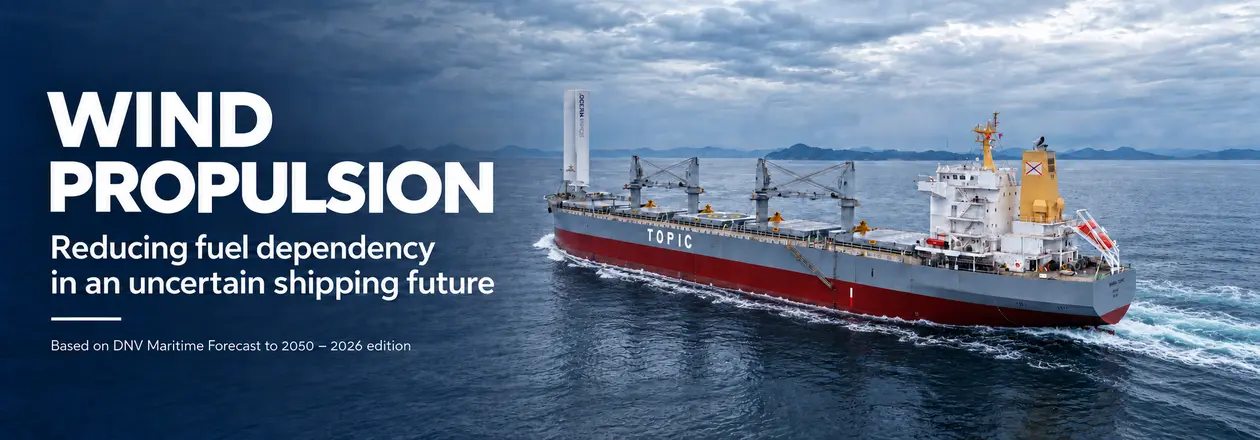
A Wind-Assisted Propulsion System is not simply another efficiency measure. Wind is a source of propulsive energy.
By converting an energy source already available at sea into aerodynamic thrust, OceanWings reduces the power required from the main propulsion system, and therefore the amount of fuel the vessel needs to bunker.
That remains valuable regardless of what sits in the tank: conventional fuels today, or biofuels, methanol, ammonia and other low-GHG fuels tomorrow.
For shipowners, this creates a natural hedge against one of the transition’s biggest uncertainties: the future cost and availability of marine energy.
Wind requires no fuel production capacity, no bunkering infrastructure and no bet on which alternative fuel pathway will ultimately prevail.
Every MWh delivered by wind is a MWh that does not need to be purchased as fuel, or carry the associated carbon-cost exposure.
The future fuel mix remains uncertain. The value of needing less of it does not.
References
DNV, Maritime Forecast to 2050 – 2026 edition.
https://www.dnv.com/maritime/maritime-forecast/
About OceanWings
OceanWings’ mission is to provide the shipping industry with the most efficient wind-assisted propulsion systems, enabling them to reduce emissions, lower operational costs, and protect the long-term value of their investments. By making innovative technology accessible, OceanWings aims to become a global leader in the decarbonization of shipping, helping steer the industry towards wind energy as the most scalable and ready solution for a sustainable future.
For more information, visit: OceanWings – Wind Assisted Propulsion Systems