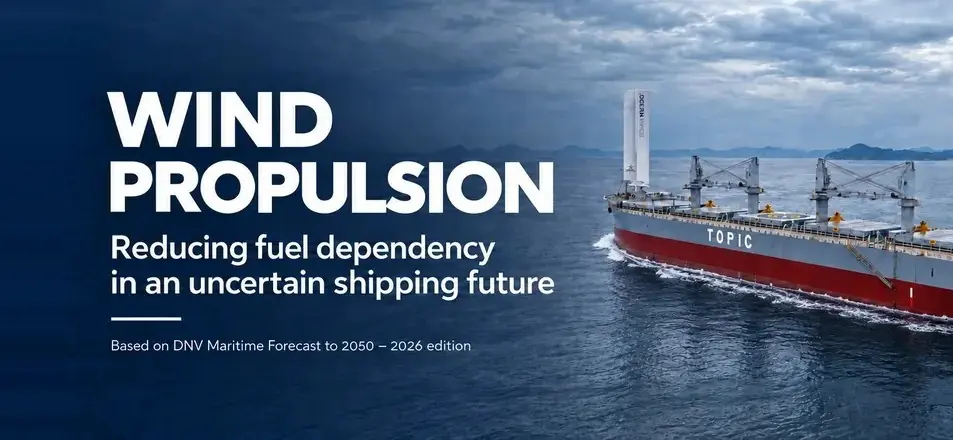
Amid the growing need to improve the energy efficiency of ships, the maritime industry is turning back to a traditional energy source: wind.
Tightening environmental regulations and volatile fuel costs are pushing the shipping industry to reconsider fuel-efficiency management. Notably, the 84th session of the IMO’s Marine Environment Protection Committee (MEPC 84), held from 27 April to 1 May 2026, advanced discussions on the adoption of the IMO Net-Zero Framework (IMO NZF), with negotiations set to continue at the next extraordinary session of MEPC on 4 December 2026.
In this context, wind-assisted propulsion systems (WAPS) have gained significant attention as a promising solution, and market adoption is approaching a tipping point. They provide a practical solution, enabling maritime operators to meet regulatory requirements while advancing long-term decarbonization goals. This article explores WAPS technologies and highlights their tangible benefits in addressing the industry’s most pressing challenges.
I. What are wind-assisted propulsion systems (WAPS)?
Wind-assisted propulsion systems (WAPS) are technologies that use wind power to supplement a ship’s main engine. These systems generate additional thrust from wind, thereby reducing engine load, fuel consumption, and greenhouse gas (GHG) emissions.
WAPS can significantly contribute to propulsion, depending strongly on vessel type, operational profile, and weather conditions. Actual fuel savings are influenced not only by aerodynamic performance but also by the system’s energy consumption and its ability to operate effectively across real trading conditions.
II. Different types of wind-assisted propulsion systems (WAPS)
Several wind-assisted propulsion technologies are currently deployed in commercial shipping, primarily wingsails, rotor sails, and suction sails. While all aim to reduce fuel consumption and emissions, they rely on different aerodynamic principles and system architectures. These differences translate into varying levels of performance, energy efficiency, and operational flexibility in real-world conditions.
1) Wingsails
Wingsails are vertical structures that operate similarly to aircraft wings. They generate propulsion through lift created by a pressure difference between the windward and leeward sides of the profile (Bernoulli’s principle).
Their geometry can be actively adjusted to optimize performance depending on wind conditions. Thanks to their high aerodynamic efficiency, wingsails can generate positive thrust across a wide range of apparent wind angles (AWA), including upwind and low-angle headwind conditions (representing approximately 75% of real operating conditions).
Unlike active systems, wingsails primarily require power for actuation and control rather than continuous aerodynamic operation, resulting in lower auxiliary energy demand. OceanWings, for example, typically consume 1 kW per wingsail during normal operations.
The streamlined airfoils generate negligible drag, facilitating ship operations, especially during emergency and docking manoeuvres (i.e., feather mode).
2) Rotor sails
Rotor sails, also known as Flettner rotors, are vertical cylinders that rotate at speeds of up to 300 rpm using an electric motor. When wind interacts with the spinning cylinder, airflow accelerates on one side and decelerates on the other, creating a pressure difference that generates thrust (Magnus effect).
Rotor sails are active systems, requiring continuous power input (approximately 150 kW per rotor, depending on size and operation), introducing an additional energy demand that can influence overall net savings.
Rotor sails generate their strongest thrust under side-wind conditions (approximately 15% of real operating conditions) and their contribution is limited at very low apparent wind angles (AWA < 20°).
The large cross-section of the rotors increase aerodynamic drag, which is detrimental for upwind efficiency and for manoeuvring in strong winds.
3) Suction sails
Suction sails are wing-shaped bluff bodies that generate aerodynamic lift through active boundary layer control. Fans or suction devices draw air through a porous surface to delay flow separation and increase lift.
Suction sails are active devices and require power input (approximately 50 kW per suction sail) to maximize lift, introducing an energy requirement that can affect net performance outcomes.
Similar to rotor sails, suction sails can deliver savings under side-wind conditions (approximately 15% of real operating conditions) but may offer limited contribution in upwind conditions (AWA < 15°).
Device power demand and maintenance are the two main challenges to generating positive savings with a suction sail.
III. What are the benefits of wind-assisted propulsion systems (WAPS) in 2026?
1) Meeting regulatory requirements
The maritime sector is facing rapidly evolving environmental regulations, with frameworks from the EU (e.g., FuelEU Maritime and the EU ETS) and the International Maritime Organization (e.g., CII, EEXI, and EEDI) already driving significant changes. Compliance now requires concrete measures to meet stricter emissions targets, while additional regional mandates are further accelerating decarbonization efforts. Despite last year’s delay in adopting the IMO Net-Zero Framework (IMO NZF), these regional mechanisms continue to push the industry toward cleaner energy.
Most recently, MEPC 84, held from 27 April to 1 May 2026, advanced discussions on the adoption of the IMO NZF, which would become the first legally binding international regulation of the maritime sector if adopted. In this context, WAPS provide a practical solution, enabling maritime operators to reduce fuel consumption by harnessing the power of wind — the “best fuel” being the one that is freely available and not burned — while helping them comply with regulatory requirements and accelerate long-term decarbonization objectives.
2) Improving fuel efficiency of ships
A key challenge facing the shipping industry is the volatility of oil prices. Fuel-price volatility is driven by geopolitical and economic events, weather, and the uncertainty they create in supply and demand. Most recently, international tensions have further accelerated price increases, pushing oil prices toward record highs. In this context of extreme volatility and uncertainty, the energy transition is no longer optional but rather essential. WAPS offer a viable solution by harnessing wind energy to improve fuel efficiency and reduce dependence on costly fossil fuels.
3) Contributing to the decarbonization of ships
Even though shipping is often considered a relatively clean mode of transport, it still accounts for almost 3% of global CO₂ emissions. According to the OECD, emissions from maritime transport increased by 9.4% from 2019 to 2024, with container ships and bulk carriers contributing almost half of total vessel emissions. In this context, WAPS are emerging as a key solution to support the industry’s decarbonization goals and contribute to the fight against climate change.
IV. Why choose OceanWings for wind-assisted propulsion systems (WAPS)?
OceanWings provides rigid wingsails that perform effectively in diverse marine conditions. Specifically:
1) Fuel savings for best-in-class payback
OceanWings delivers best-in-class fuel and emissions reductions, ranging from 15% to 50%. This represents approximately 1.3 tonnes of average fuel savings per day per wingsail. OceanWings’ wing sails can generate positive thrust across a wide range of apparent wind angles (AWA), starting from as low as 5°. The resulting fuel savings enable a competitive payback period depending on vessel type and fuel costs.
2) Safe, adaptable, and robust design
The system is fully automated and safe by design, requiring no extra crew or special training. In the event of potential risk, OceanWings can quickly switch to feather mode—a passive mode that remains stable in winds up to 100 knots. In addition, OceanWings produces neither noise nor vibration and requires extremely low power. It also requires minimal maintenance, thanks to the absence of rotating equipment or active systems. On average over the past two years on Canopée, OceanWings showed 99.6% operational availability.
3) Compatible and lightweight design
Thanks to their modular design, OceanWings' wingsails are compatible with diverse operations:
- Tanker operations (intrinsically safe designs for Ex-rated environments)
- Bulk carrier operations (compact when tilted on deck)
- Containership operations (no interference with gantry cranes due to the elevator system)
Moreover, the system’s lightweight design simplifies mechanical integration and minimize the impact on deck space.
To learn more about the benefits: Benefits for Shipping - OceanWings
V. Conclusion
Whether through WAPS, renewable energy, or other efficiency measures, energy-efficiency management has become essential to address the growing operational, economic, and regulatory pressures facing the shipping industry. Among the available solutions, WAPS stand out for their immediate and transformative impact: they harness wind — a free, globally available, and fully independent energy source — without requiring any dedicated fuel infrastructure, port adaptation, or new energy supply chains.
Available today and deployable on existing vessels, WAPS offer shipowners a pragmatic and scalable pathway to reduce fuel consumption, strengthen energy resilience, and accelerate maritime decarbonization. Installing WAPS is therefore not only a strategic efficiency decision, but also a concrete and actionable response to the industry's transition challenges.
*Unless otherwise stated, the data are based on OceanWings’ internal modeling.
VI. References
Deybach, F., Lafoux, B., & Robert, C. (2025). Wind Assisted Propulsion Systems: a key to reduce CO₂ and methane emissions (pp. 3–30).
Maritime transport CO2 emissions. (n.d.). OECD. Retrieved May 12, 2026, from https://www.oecd.org/en/data/datasets/maritime-transport-co2-emissions.html
About OceanWings
OceanWings’ mission is to provide the shipping industry with the most efficient wind-assisted propulsion systems, enabling them to reduce emissions, lower operational costs, and protect the long-term value of their investments. By making innovative technology accessible, OceanWings aims to become a global leader in the decarbonization of shipping, helping steer the industry towards wind energy as the most scalable and ready solution for a sustainable future.
For more information, visit: OceanWings – Wind Assisted Propulsion Systems