The shipping industry may be entering a new regulatory era with the IMO Net-Zero Framework (NZF), the first proposed global regulatory framework specifically designed to decarbonize the maritime sector. Although the Marine Environment Protection Committee (MEPC) postponed adoption, technical work will continue, and the proposed draft guidelines can already help companies prepare for the future.
This article aims to provide a comprehensive overview of the NZF, including its mechanisms, tentative timeline, and future outlook.
[UPDATE] MEPC 84: Progress Toward Consensus
The 84th session of the MEPC (MEPC 84) took place from 27 April to 1 May 2026, following the meeting of the Intersessional Working Group on Reduction of GHG Emissions from Ships (ISWG-GHG 21). Although no final agreement was reached, member states agreed to continue negotiations and work toward a compromise, recognizing the importance of a global IMO measure.
This article covers the key outcomes of MEPC 84, in Section V.
I. What is the IMO Net-Zero Framework (NZF)?
The IMO Net-Zero Framework (NZF) is a proposed international regulatory framework developed by the International Maritime Organization (IMO) to reduce greenhouse gas (GHG) emissions from the shipping industry, in line with the 2023 IMO GHG Strategy.
The framework was approved during the 83rd session of the MEPC (MEPC 83) in April 2025 as amendments to Annex VI of the International Convention for the Prevention of Pollution from Ships (MARPOL). The amendments were originally expected to be adopted as legally binding measures during the extraordinary MEPC session (MEPC ES.2) in October 2025.
However, IMO member states agreed to postpone the adoption discussions due to ongoing disagreements over several core provisions.
If ultimately adopted, the NZF would become the first global regulatory framework specifically designed to decarbonize the maritime sector, aligning with Article 2 of the Paris Agreement.
II. How does the IMO Net-Zero Framework work?
The IMO Net-Zero Framework combines a global fuel standard with a pricing and reward system tied to emissions performance. The thresholds are set using a metric called GHG Fuel Intensity (GFI), which represents how much GHG is produced per unit of energy used. The framework applies a “well-to-wake” methodology, meaning emissions are assessed across the full fuel lifecycle — from production to onboard consumption. Under the NZF, annual GFI targets become progressively stricter over time.
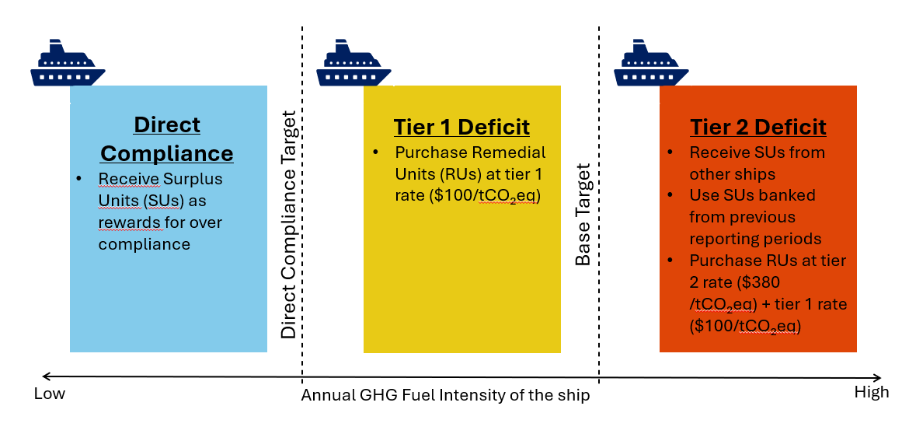
The annual GFI consists of two tiers: the “Base Target” and the “Direct Compliance Target.” Ships performing below the Direct Compliance Target will receive Surplus Units (SUs) from the Net-Zero Fund as a reward. These SUs can be banked for future reporting periods. Ships exceeding the Direct Compliance Target but remaining below the Base Target must purchase Remedial Units (RUs) at a rate of USD 100/tCO₂eq to compensate for excess emissions. Ships exceeding the Base Target must: 1) acquire SUs transferred from other over-compliant ships, or 2) use banked SUs from previous reporting periods, or 3) purchase RUs at a rate of USD 380/tCO₂eq plus USD 100/tCO₂eq.
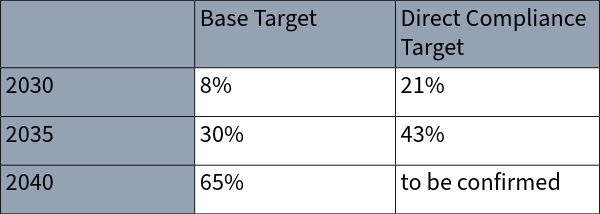
The provisional annual targets are proposed for each year in percentage relative to the GFI reference value (the average GFI of international shipping in 2008: 93.3 gCO2eq/MJ).
III. Which ships will be affected by the IMO Net-Zero Framework?
The NZF is expected to apply to ships above 5,000 GT engaged in international trade, representing approximately 85% of international shipping CO₂ emissions. In other words, large vessels such as container ships, oil and gas tankers, bulk carriers, cruise ships, and Ro-Ro vessels are expected to be the most affected. Discussions are also ongoing regarding the inclusion of ships between 400 GT and 5,000 GT in the future.
IV. Why was the Net-Zero Framework postponed?
The NZF was expected to be adopted during MEPC ES.2 in October 2025. However, consensus was not reached, and discussions on its adoption were postponed. The postponement reflected political pressures and divergent views among member states regarding several core provisions, including concerns over overlaps with regional regulations and implementation burdens. In this context, the IMO opted to allow additional time for further discussions in order to reach a legitimate conclusion.
V. What were the outcomes of MEPC 84?
The 84th session of the MEPC (MEPC 84) took place from 27 April to 1 May 2026, following the meeting of the Intersessional Working Group on Reduction of GHG Emissions from Ships (ISWG-GHG 21).
MEPC 84 was the first opportunity to discuss the NZF following MEPC ES.2. No final agreement was reached, as views among member states remained divergent. However, member states shared the view that a global IMO measure is important in order to avoid a fragmented regulatory landscape shaped by different regional regulations. There was clear consensus among member states to continue negotiations and work toward a compromise by amending the NZF.
MEPC 84 made progress in the following areas:
- Draft guidelines for the calculation of GHG Fuel Intensity (GFI)
- Draft guidelines on how to monitor, report and verify the energy generation from wind propulsion systems
- Draft amendments to the 2022 Guidelines for Administration Verification of Ship Fuel Oil Consumption Data and Operational Carbon Intensity
- Draft criteria for zero- and near-zero-GHG fuels (ZNZs) and reward guidelines
- Draft guidance for Sustainable Fuel Certification Systems (SFCS)
IMO GFI Registry
The GFI Registry plays a key role in tracking, recording, and verifying each ship’s compliance status, including SUs and RUs acquired, GFI calculations, and transfer and cancellation records. Future sessions of ISWG-GHG will work on calculating the possible costs involved, as well as developing functional requirements.
IMO Net-Zero Fund
The Net-Zero Fund is the core component of the NZF and is intended to manage the pricing and reward mechanism. As member states were not aligned on its scope, timing, and legal footing, further regulatory clarity—including its governance and the possible disbursement of revenues—is still required to reach a consensus.
Integration of wind propulsion into the framework
ISWG-GHG 21 discussed whether wind propulsion energy should be integrated into GFI calculations. Although the European Union (EU) previously chose to apply a limited reward factor instead of direct integration, the IMO considers full integration of wind propulsion to be a legitimate propulsion energy source. In addition, ISWG-GHG 21 discussed establishing a separate reward mechanism for ZNZs, including wind propulsion. These topics will continue to be discussed in future meetings.
Before MEPC 85 (30 November–3 December 2026) and the provisionally-scheduled MEPC ES.2 (4 December 2026), two ISWG-GHG meetings (1–4 September, 23–27 November 2026) are expected to continue discussions. If a compromise is reached, it will enter into force in 2029 earliest.
VI. How should companies prepare for the future maritime regulations?
Amid geopolitical tensions and the fuel price volatility, future maritime regulations remain highly uncertain. While comprehensive international regulations are still lacking, regional regulations such as the EU ETS and FuelEU Maritime will continue to evolve. Beyond the EU, the UK ETS will expand to include the maritime sector from July 2026. Although China's national ETS has not yet included the maritime sector, it has gradually expanded to cover additional industries, suggesting the possibility of extending its scope to shipping in the future. These regional regulations may help companies prepare for the future NZF. Whether through alternative fuels, voyage optimization, or wind-assisted propulsion systems (WAPS), investing in fuel-efficiency improvements today may help reduce future compliance costs while strengthening long-term competitiveness.
VII. How does OceanWings help with regulatory compliance?
OceanWings develops and installs rigid wingsails that generate aerodynamic thrust to supplement the main engine. The system delivers positive thrust in most wind conditions, including challenging headwinds. Thanks to its passive systems, OceanWings requires extremely low energy consumption (typically 1 kW per wingsail during normal operations), as well as minimal maintenance (99.6% operational availability demonstrated on Canopée.)
The resulting fuel savings are best-in-class, with approximately 1.3 tonnes of average fuel savings per day per wingsail. These fuel savings reduce annual GHG emissions and, consequently, extend compliance and lower the financial penalties under various regulations, including the EU ETS, FuelEU Maritime, CII, EEXI, and EEDI, and the future NZF.
About OceanWings
OceanWings’ mission is to provide the shipping industry with the most efficient wind-assisted propulsion systems, enabling them to reduce emissions, lower operational costs, and protect the long-term value of their investments. By making innovative technology accessible, OceanWings aims to become a global leader in the decarbonization of shipping, helping steer the industry towards wind energy as the most scalable and ready solution for a sustainable future.
For more information, visit: OceanWings – Wind Assisted Propulsion Systems