Same sail area, very different results
Two wind-assisted propulsion systems (WAPS) can have the same sail area on paper and deliver very different savings at sea.
In wind-assisted ship propulsion, size on paper is not the same as performance on board.
The reason is simple: not all of that area sees the same wind. Whether it is a wingsail or another system, every WAPS works in the airflow the ship leaves it.
The advantage of reaching higher above the deck is cleaner, stronger wind. Closer to the deck, the hull and superstructure break that airflow up.
So the real question for a shipowner is not how big a system is, but how much of it actually performs.
Sail area defines a system's potential. Where that area sits in the wind decides how much of it is realised.
Why the wind is slower close to the sea
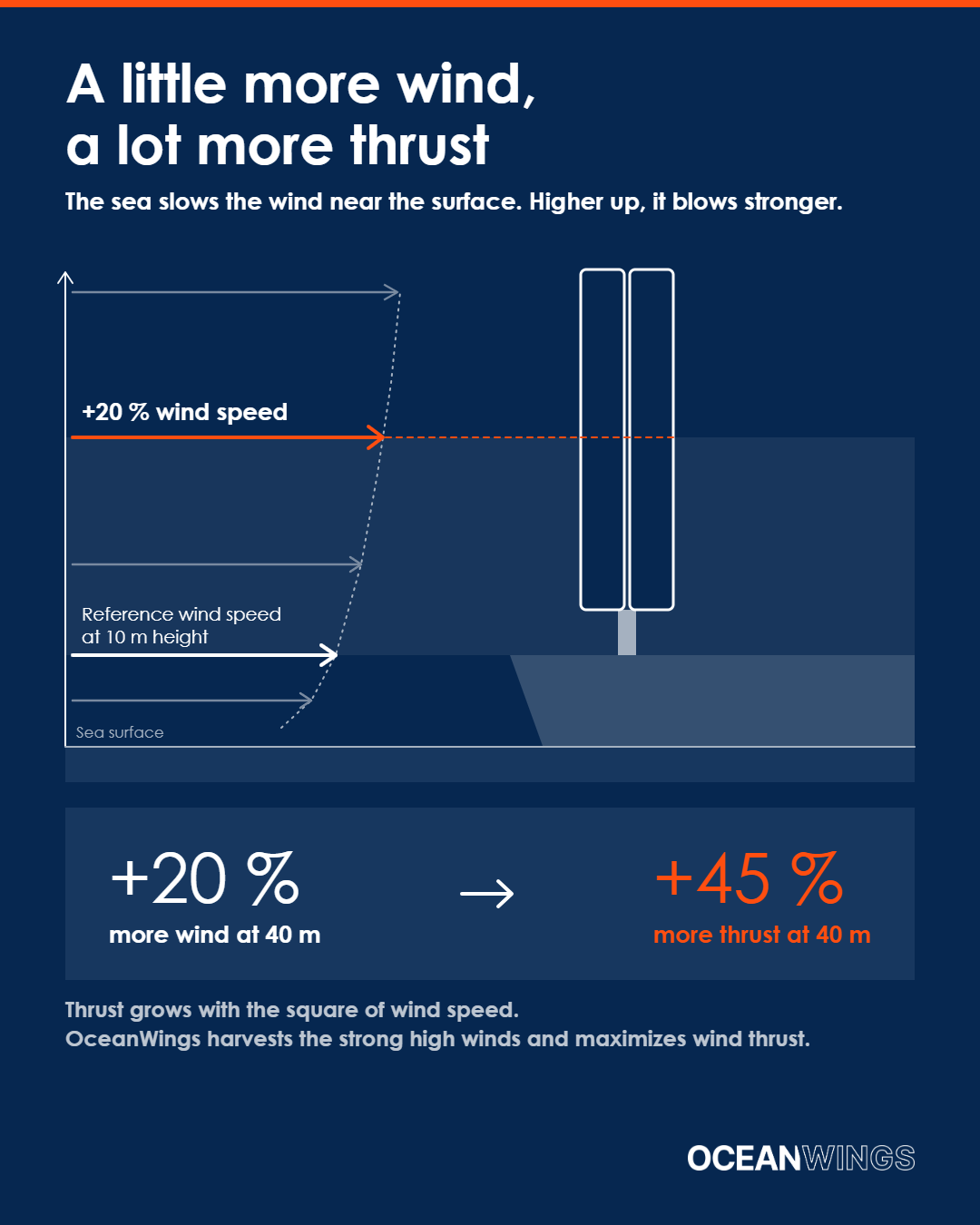
Wind speed above the sea is not uniform with height. Close to the sea surface, the moving air is slowed down by friction against the water and by the viscosity of the air itself.
This creates the atmospheric boundary layer: a vertical wind gradient profile, where wind speed is lowest at sea level and increases with height (ITTC, 2024). The effect is strongest in the first meters above the sea.
The aerodynamic forces grow with the square of wind speed. An increase in wind speed leads to a much larger change in force. Over open sea, wind at 40 meters is typically 20% faster than at 10 meters, which means around 44% more aerodynamic force.
But for a WAPS installed on a ship, the wind gradient is the smaller part of the story.
The ship is the real obstacle
A large commercial ship is not transparent to wind. As airflow meets the hull, it is displaced and redirected, creating turbulence and local changes in velocity.
The effect is large and measurable. On the wind-assisted RoRo Canopée, fitted with four Lowerable Fixed Wingsails (OW LF), aerodynamic studies showed that the ship’s superstructure changes how much each wingsail contributes, both along its height and from one wingsail to another, depending on how exposed each one is to the disturbed airflow (Guillouzouic et al., 2024).
These effects are not specific to one ship. Simulations of cargo ships with different proportions show large zones of disturbed airflow above the deck, which change with the hull shape and the wind direction (Renzsch & Thies, 2026).
This applies to every WAPS, regardless of technology. However, a tall system, such as an OceanWings wingsail, places most of its surface above the disturbed zone, whereas shorter systems, closer to the deck, expose much of their surface to disturbed airflow.
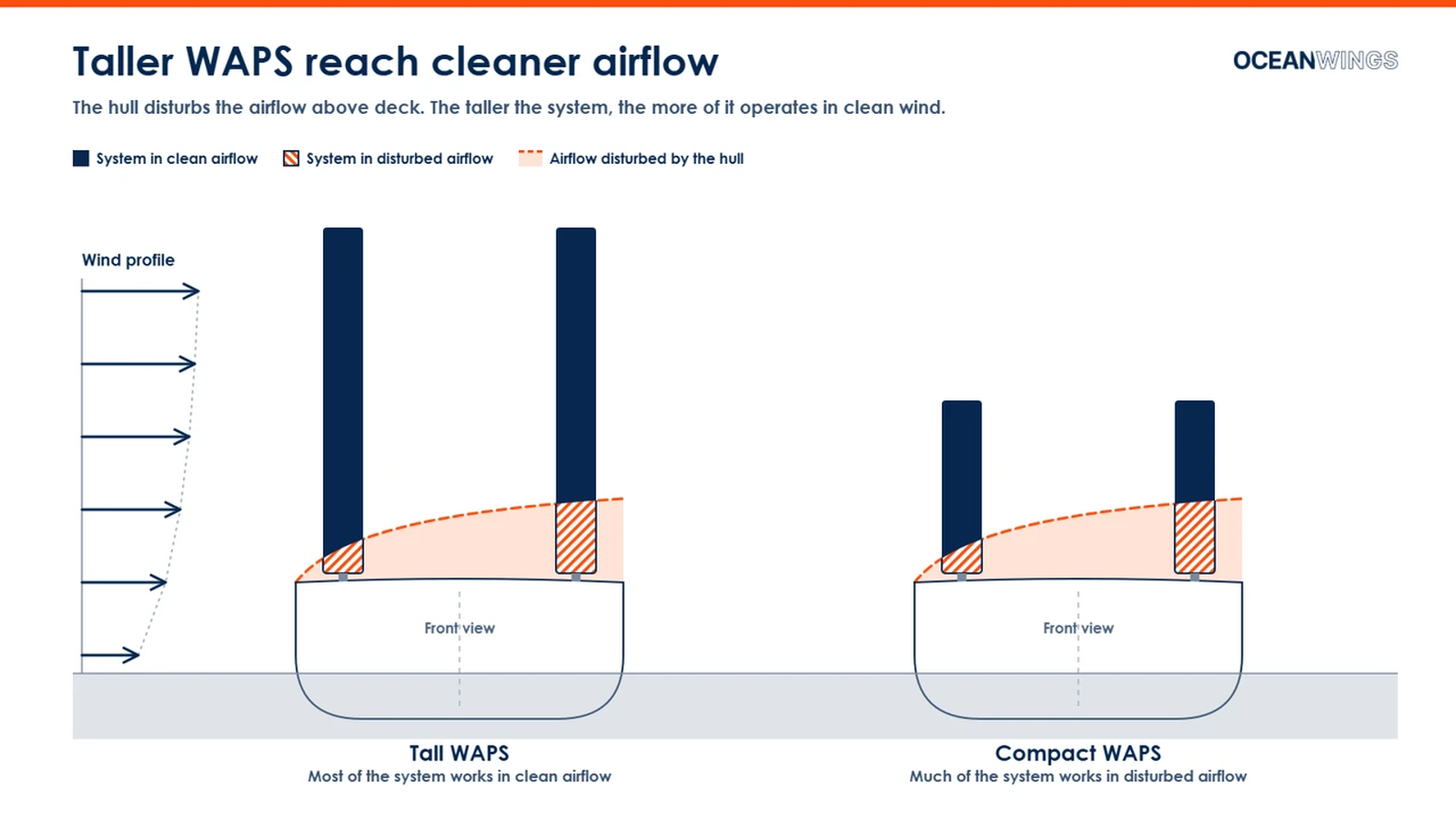
For shipowners, this belongs in every investment decision. Two systems with similar sail area, but different heights, do not have access to the same wind.
Height only counts if you can take it into port
A tall system has to live with the realities of commercial operations. Each vessel type has its own constraints: weight, air draft, bridges, cranes and cargo operations.
Tankers, bulk carriers and container ships each set different limits. A system that cannot adapt to them ends up shorter than it should be, and works lower in the ship's disturbed airflow.
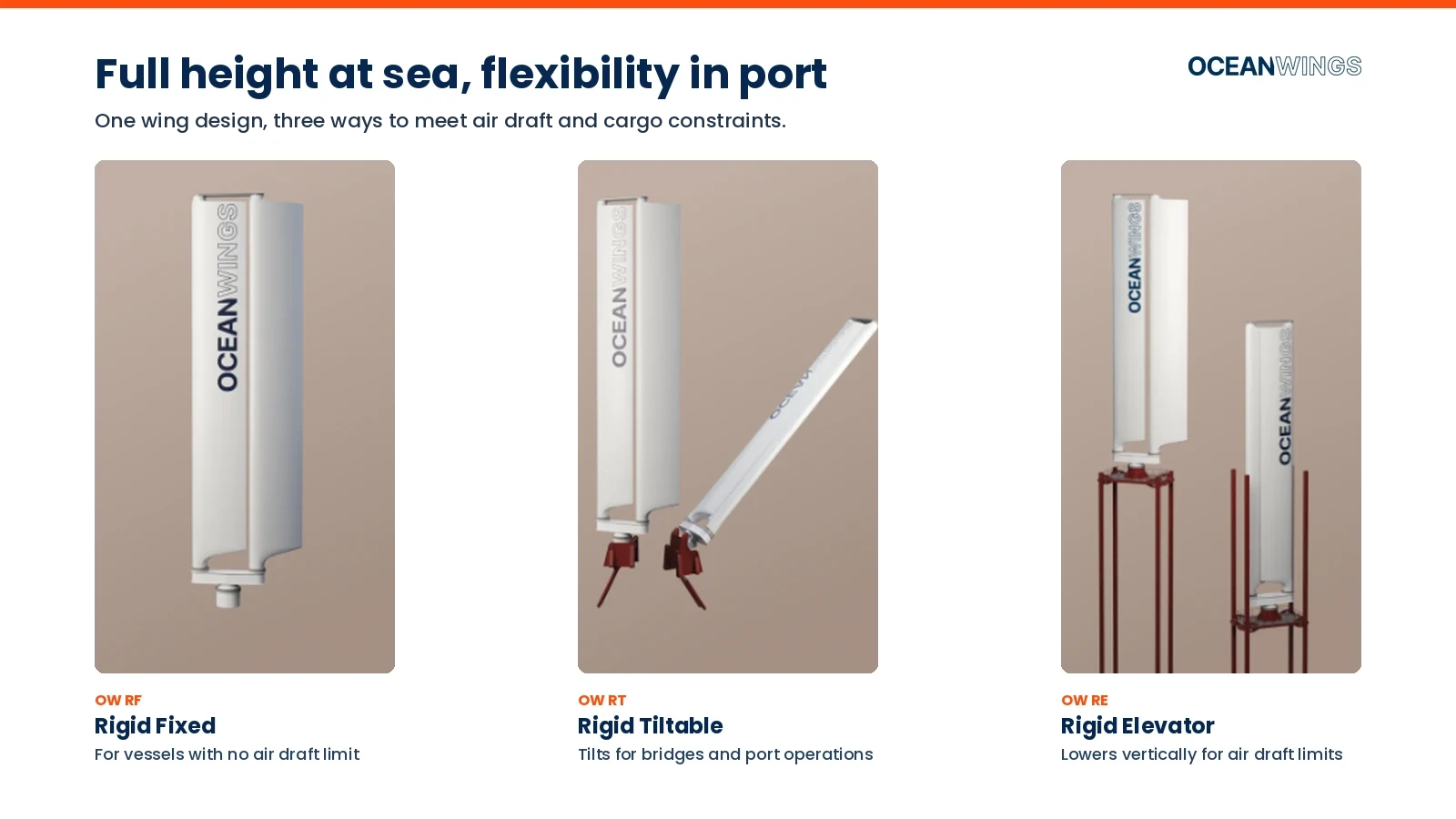
This is why the OceanWings range covers rigid fixed, tiltable, and elevator wingsails.
Depending on the vessel, the wingsail keeps its full height at sea, where it creates value, and steps aside when air draft or cargo operations require it.
From clean airflow to fuel savings
Wind is not a way to make an engine more efficient. It is an external source of propulsive energy, and every WAPS turns part of it into forward thrust.
The chain is short:
- Clean airflow. Height and position decide how much of the system works above the ship's disturbed air.
- Aerodynamic force. Cleaner, faster airflow produces more force, growing with the square of wind speed.
- Thrust. The forward part of that force pushes the ship.
- Engine power savings. The main engine delivers less of the propulsive effort, cutting fuel consumption and emissions.
Every step depends on the first. A WAPS can only convert the wind that actually reaches it, which is why height is a direct lever on ship savings efficiency.
Questions to ask any WAPS supplier
Sail area and theoretical thrust savings are only the starting point. Before investing in wind propulsion for shipping, ask these questions. OceanWings rigid wingsails are built around them.
1. How much of the sail works above the ship’s disturbed airflow?
The airflow around a ship’s hull and superstructure is disturbed, which reduces the thrust a sail can produce on a real vessel compared with figures on paper. OceanWings rigid wingsails are tall, placing most of their surface above this disturbed airflow, where the wind is most useful.
2. What happens in port?
A WAPS must cope with air draft limits, cranes and cargo operations without losing height at sea. OceanWings offers fixed, tiltable, and elevator versions that keep full height at sea and adapt to air draft and cargo operations in port.
3. Can the crew run it without becoming sailors?
Automation, maintenance and repairability decide whether fuel savings last over the ship’s life. OceanWings is a fully automated wind-assisted propulsion system, with maintainability and industrial maturity designed in from the start. On Canopée, OceanWings has achieved 99.6% average operational availability over two years.
The result is wind-assisted propulsion that performs in everyday commercial service. In the words of a shipowner who visited our factory in 2026: “This is not experimental innovation, it is engineered maritime equipment.”
Want to see how much of your sail area would really work on your vessel? Talk to our team.
About OceanWings
OceanWings' mission is to provide the shipping industry with the most efficient wind-assisted propulsion systems, enabling them to reduce emissions, lower operational costs, and protect the long-term value of their investments. By making innovative technology accessible, OceanWings aims to become a global leader in the decarbonisation of shipping, helping steer the industry towards wind energy as the most scalable and ready solution for a sustainable future.
For more information, visit: OceanWings – Wind Assisted Propulsion Systems
References
- Guillouzouic, B., Provinciali, G., Guisnel, X., & Watin, S. (2024). From theoretical performance prediction to operation and on-board measurements: Review of a complete journey along Canopée project. RINA International Conference on Wind Propulsion.
- ITTC (2024). Predicting the power saving of wind powered ships (Recommended Procedures and Guidelines 7.5-02-03-01.9, Revision 00). Specialist Committee on Wind Powered and Wind Assisted Ships of the 30th ITTC. International Towing Tank Conference.
- Renzsch, H., & Thies, F. (2026). Parametric study on the influence of ship hull proportions on the inflow to wind-assisted propulsion systems. INNOV’SAIL 2026, 7th International Conference on Innovation in High Performance Sailing Yachts and Wind Assisted Ships, Gothenburg, Sweden.